An EV charger HMI now has legal jobs as well as a user interface. EU, UK and US rules require the price to be shown before charging, card-based contactless payment at many public chargers, and accessible, reliable operation. The screen, payment reader, controller board and back-end must be specified together for each target market.
This guide is written by the engineering team of Beijing Huamei Xuntong Technology Co., Ltd. (TouchVision), a manufacturer founded in 2012 that designs and builds industrial displays, embedded boards, HMI panels, industrial gateways and edge AI computers.
Key takeaways
- EU AFIR, the UK Public Charge Point Regulations 2023, US NEVI rules and German law all regulate what the charger screen shows and how drivers pay.
- Plan for contactless card payment: AFIR for new chargers of 50 kW or more, the UK for new chargers from 8 kW and all from 50 kW, NEVI-funded US sites, and German chargers commissioned from 1 July 2024.
- Show the price before charging; the UK requires a maximum price in pence per kWh, and AFIR requires per-kWh pricing at 50 kW and above.
- Uptime targets (99% for UK rapid chargers, above 97% per port under NEVI) make watchdogs, fanless design and remote diagnostics part of the HMI specification.
- Accessibility (screen height, no rapid flashing, reach to the reader) and calibration-law data display should be designed in from the start.
Why do regulations now shape the EV charger HMI?
Public charging rules in the EU, the UK, the US and Germany all regulate what the driver sees and how the driver pays, so the screen and the board behind it are no longer purely a design choice. An HMI that cannot show a per-kWh price, host a card reader or report its status can make a charger hard to sell in those markets.
The EV charger HMI usually covers four things: the display and touch panel, the payment and identification devices (contactless reader, RFID card, PIN pad or QR code), the controller board that ties them together, and the software that talks to the power electronics and to the back-end over OCPP. Regulations touch all four. The sections below summarise what each market expects, then turn it into a hardware checklist. Always confirm the current legal text with your compliance adviser; this guide is engineering orientation, not legal advice.
What does the EU AFIR require at the charger?
The EU Alternative Fuels Infrastructure Regulation (AFIR) requires ad hoc charging without a contract and, for new public chargers of 50 kW or more, a payment card reader or a contactless device that can at least read payment cards. It also requires the ad hoc price to be clear before the session starts.
Regulation (EU) 2023/1804 applies across the EU. The European Commission’s AFIR questions and answers clarify several points that matter to hardware designers:
- Two kinds of reader: a “payment card reader” uses the card’s chip, while a “device with contactless functionality” reads cards over NFC. Both enable payment; they differ in how they work.
- Price per kWh above 50 kW: at recharging points of 50 kW or more, operators have to calculate the ad hoc tariff from the energy delivered, as a price per kWh. Below 50 kW, the price components must be presented in a set order.
- Points deployed from 13 April 2024: the Q&A explains that “deployed” means operational and available to users, which is the date that triggers several of the new obligations.
- Price information: it can be shown on the station or reached through a clearly available link, such as a QR code to a web page, as long as the user can see it before starting to charge.
For the HMI this means a screen able to show the full ad hoc tariff, a mounting position and cut-out for an EMV contactless or chip reader on higher-power units, and enough processing to run the payment flow alongside the charging state machine.
What does the UK Public Charge Point Regulations 2023 add?
The UK goes further on transparency and reliability: contactless payment at new public chargers from 8 kW and all chargers from 50 kW, the maximum price shown in pence per kWh, 99% reliability for rapid chargers and a free 24/7 helpline. These are the main features an EV charger HMI for the UK must support.
According to the government’s Public Charge Point Regulations 2023 guidance, contactless payment had to be available at the relevant charge points by 24 November 2024, either per charge point or per site. The maximum price of a session must be clearly displayed in pence (or pounds) per kilowatt hour, either on the unit itself or via another device that needs no contract, and it must not rise once charging has started. Rapid charge points must be 99% reliable, and operators must publish open data. The guidance also notes that the helpline, pricing and contactless requirements apply to the physical cabinet rather than to each outlet, so one well-placed screen and reader can serve a dual-outlet unit. The legal text is on legislation.gov.uk.
The reliability rule puts pressure on the hardware. A frozen screen or a crashed payment application counts as downtime even when the power stage is healthy, so a hardware watchdog, a recovery partition and remote diagnostics become part of the EV charger HMI specification.
What do US NEVI rules require of the screen and payment?
Federally funded US chargers under the NEVI program must accept major debit and credit cards contactlessly, offer a toll-free phone or SMS payment option, require no membership, and be accessible to people with disabilities. The rules also require each charging port to reach an average annual uptime above 97% and the price to be clearly displayed.
The payment section of 23 CFR 680.106 requires secure payment options that people with disabilities can use, including at minimum a contactless method for major cards and either an automated toll-free number or SMS that lets the customer start and pay for a session. It also forbids requiring a membership. For accessibility, the US Access Board’s EV charging guidance points to Section 508 requirements for display screens, which should be visible from a point 40 inches above the ground or floor and should avoid flashing more than three times per second. Reach ranges and operable parts also matter, so the screen height and the reader position are part of accessibility design, not only industrial design.
What does German calibration law mean for the display?
In Germany, energy readings used for billing must be verifiable by the customer, and since mid-2024 newly commissioned public chargers must accept contactless debit and credit cards. Both affect what the charger shows and stores.
Germany’s metrology institute PTB explains that charging-station meter values may be used for billing only if the customer has access to transparency software validated by the responsible notified body; this is the core of what the industry calls Eichrecht compliance. The 2023 amendment to the Charging Station Ordinance requires contactless payment with at least a common debit and credit card system at the charge point or close to it, and allows an additional web-based payment if menus are available in German and English. The amendment applies to charge points commissioned from 1 July 2024. For the HMI, that means a German and English user interface, a place for a contactless reader and a way to present signed meter data so drivers can check their bill.
How do the rules translate into hardware requirements?
Most of the rules land on four components: the display and touch panel, the payment reader position, the controller board’s interfaces, and the reliability features in the software stack. The table maps each requirement to a design decision.
| Requirement | Where it comes from | What the EV charger HMI needs |
|---|---|---|
| Price visible before charging | AFIR, UK PCPR, German ordinance | A readable display or a QR link to the tariff; layout space for per-kWh and other price components |
| Contactless card payment | AFIR (≥50 kW new), UK (≥8 kW new, ≥50 kW all), NEVI, Germany | Cut-out and mounting for an EMV reader; serial or USB link from the board to the reader |
| High charger uptime | UK 99% for rapid chargers, NEVI above 97% annual average per port | Watchdog, fanless design, wide temperature range, remote diagnostics over OCPP |
| Accessibility | NEVI and US Access Board, EU and national rules | Screen height and viewing angle, contrast, no rapid flashing, large touch targets, audio prompts |
| Verifiable billing data | German calibration law | Display or export of signed meter values, storage for transaction data |
| Multilingual UI | German ordinance (German and English menus for web payment), multi-country networks | Unicode fonts, language switch, enough flash for language packs |
On the board side, chargers commonly need several RS-485 ports for the energy meter, power modules and reader, CAN for the power stage or vehicle-side controller, Ethernet or 4G for OCPP, and a real-time clock for tariff periods. Outdoors, the display needs high brightness, anti-glare glass and an IP65 front, and the touch technology should work with gloves and in rain; our infrared vs capacitive comparison covers that choice, and the sunlight readable display guide covers brightness.
What should be on your EV charger HMI checklist?
Use this checklist when you write the specification or audit an existing charger platform for a new market. It covers the items that most often cause redesigns late in a project.
- Target markets listed, with the payment and price-display rule for each power class.
- Reader space reserved in the front panel, even on models that launch without one.
- Display size and brightness chosen for the full tariff text and outdoor sun.
- Touch technology tested with gloves, rain and thick glass.
- Controller interfaces counted: RS-485, CAN, Ethernet, 4G, USB for reader and peripherals.
- Reliability features: hardware watchdog, safe firmware update, remote logs, wide-temperature parts.
- Accessible charging station check: screen height, viewing angle, flashing, audio and reach to the reader.
- Software ownership agreed: who supplies OCPP, payment and calibration-law software.
- Second-source HMI: a mechanical and electrical drop-in alternative for the display and board.
Which TouchVision parts are used in EV charger HMIs?
TouchVision supplies the display, touch panel and controller board for charger HMIs, from 7-inch to 15.6-inch and larger screens, and can match the outline of an existing part as a drop-in second source. Charger software such as OCPP and payment integration comes from the charger maker or is agreed per project.
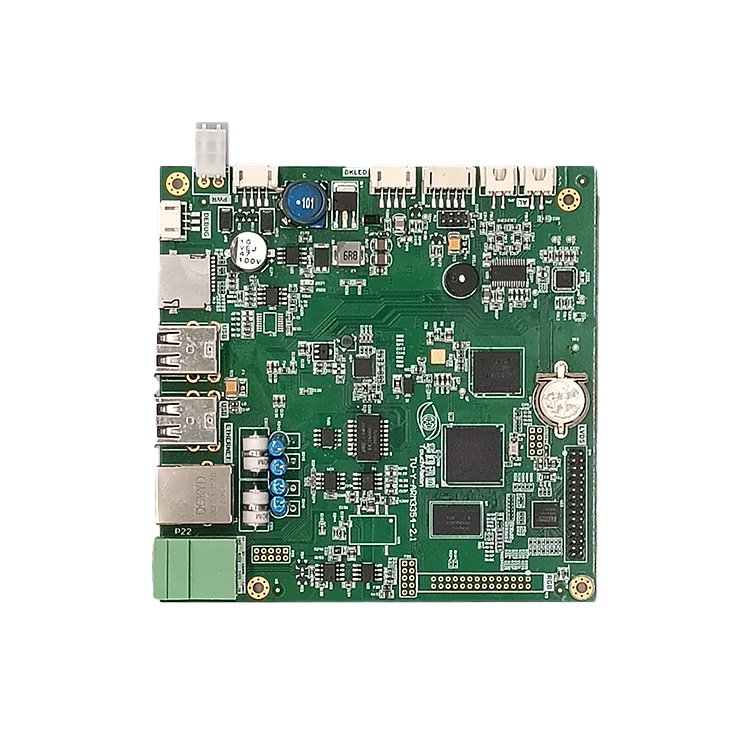
The TV-RK3568 industrial motherboard suits rich Android or Linux interfaces: four Cortex-A55 cores at 2.0 GHz, dual LVDS, HDMI and eDP outputs, five RS-485 ports, CAN, gigabit Ethernet, Wi-Fi and Bluetooth 5.0, 24 V input and a −20 to +85 °C rating. For cost-optimised AC chargers, the fanless TV-AM3354 board offers LVDS/RGB display output, five RS-485 ports, 10/100 Ethernet, a watchdog, RTC and buzzer, Linux with Qt, and −20 to +85 °C operation, and the factory lists EV chargers among its applications. The AM3354 2-in-1 display control board adds an onboard LED backlight driver, with a 12 V version offering CAN and two RS-232 ports and a 24 V version offering five RS-485 ports. Displays come with infrared or PCAP touch, toughened anti-glare glass and an IP65 front, such as the infrared touch screen series.
For more on choosing the processor, see RK3568 vs i.MX8M vs AM3354; for display links, see LVDS vs eDP vs MIPI DSI; and for whole-system ideas, visit our EV charging stations page.
About TouchVision. TouchVision has designed and manufactured industrial touch displays, embedded boards, panel PCs, IoT gateways and edge AI computers since 2012, from standard models to full OEM/ODM projects. Standard products carry a 3-year warranty from delivery. For bespoke builds, see our custom charger controller board design on the TouchVision OEM/ODM site, or read about us.
Frequently asked questions
Does an EV charger need a card reader under AFIR?
New publicly accessible chargers of 50 kW or more need a payment card reader or a contactless device that can at least read payment cards. Below 50 kW, AFIR also accepts secure internet-based payment, which the Commission says can in principle include a QR code leading to a payment website.
What price must a UK charger display?
The maximum price of the session must be clearly displayed in pence or pounds per kilowatt hour, either on the unit itself or via another device that needs no contract, and it cannot rise once charging starts.
What uptime do the rules require?
The UK requires 99% reliability for rapid charge points across a network. US NEVI-funded chargers must reach an average annual uptime above 97% for each charging port.
What is Eichrecht and does it affect the screen?
Eichrecht is German calibration law. Billing data from a charger can be used only if the customer can verify it with validated transparency software, so the charger must provide signed meter data, often referenced on the display or receipt.
Which board suits an EV charger HMI?
For rich Android or Linux UIs with 4G or Wi-Fi, a board such as the TV-RK3568 with five RS-485 ports and CAN is common. For cost-optimised AC chargers, an AM3354-class board with LVDS/RGB output and RS-485 is often enough.
Does TouchVision supply OCPP or payment software?
No. Charger software stacks such as OCPP and payment integration are supplied by the charger maker or agreed per project. TouchVision supplies the display, touch panel, board, BSP and HMI hardware.
Sources and standards referenced
- EUR-Lex: Regulation (EU) 2023/1804 (AFIR)
- European Commission: AFIR questions and answers
- GOV.UK: Public Charge Point Regulations 2023 guidance
- legislation.gov.uk: The Public Charge Point Regulations 2023
- eCFR: 23 CFR 680.106 installation, operation and maintenance
- US Access Board: design recommendations for accessible EV charging stations
- PTB: transparency software for e-mobility billing (German)
- Bundesgesetzblatt 2023 I Nr. 156: third amendment to the Charging Station Ordinance (German)
Need a recommendation for your project?
Send your drawings, quantities and environment through our RFQ form and a TouchVision engineer will reply with a recommended configuration, quotation and sample plan. You can also call or WhatsApp +86 135 0532 6001.