RS-485 vs CAN is not a like-for-like choice: RS-485 is only an electrical layer, usually carrying Modbus RTU with a master polling slaves, while CAN adds message priority, arbitration and error handling in silicon. Pick RS-485 for simple, cheap meter and lock buses; pick CAN for event-driven, safety-relevant machine networks.
This guide is written by the engineering team of Beijing Huamei Xuntong Technology Co., Ltd. (TouchVision), a manufacturer founded in 2012 that designs and builds industrial displays, embedded boards, HMI panels, industrial gateways and edge AI computers.
Key takeaways
- RS-485 is only an electrical layer; CAN includes framing, arbitration, error detection and retransmission in the controller.
- Modbus RTU over RS-485 relies on master polling, which is simple but slow for urgent events; CAN lets the highest-priority message win the bus.
- Both trade speed for distance, but CAN bus length falls quickly with bit rate, from 25 m at 1 Mbit/s to 1000 m at 50 kbit/s for CANopen.
- Line topology, short stubs, termination at both ends and a common reference solve most field faults on either bus.
- In practice RS-485 vs CAN is often not either-or: many products use both buses and a gateway that exposes the data as Modbus TCP or MQTT to the plant or cloud.
What is the basic difference in RS-485 vs CAN?
RS-485 defines only the voltages and wiring of a differential bus, so the protocol on top is up to you, while CAN is a complete data-link layer with framing, priority arbitration, error detection and retransmission built into every controller. That single fact explains most of the practical differences.
Both use differential signalling on twisted pair, both are multidrop, and both tolerate electrical noise well. RS-485, standardised as TIA/EIA-485, says nothing about bytes or addresses: a UART sends characters, and a higher-level protocol, most often Modbus RTU, decides who talks when. CAN, standardised in ISO 11898, specifies the frame format and how nodes share the bus. A CAN controller sends identified messages rather than addressing a particular device, and any node that cares about a message picks it up.
| Aspect | RS-485 | CAN (classic) |
|---|---|---|
| Standard | TIA/EIA-485 (electrical layer only) | ISO 11898 (data link and physical layer) |
| Typical protocol on top | Modbus RTU, vendor protocols | CANopen, J1939, vendor protocols |
| Bus access | Master polls slaves; half-duplex on two wires | Multi-master; priority arbitration by identifier |
| Error handling | Left to the protocol (for example a CRC in Modbus) | CRC, acknowledgement and automatic retransmission in hardware |
| Data per frame | Defined by the protocol | Up to 8 bytes (CAN FD: up to 64 bytes) |
| Speed and distance (TI overview) | Up to about 40 Mbit/s short range; up to about 1200 m at low rates | Up to 1 Mbit/s at about 40 m |
| Node count | 32 unit loads; more with fractional-load transceivers | Limited by transceiver and bit rate; around 30 at 1 Mbit/s in the TI overview |
| Hardware needed | UART plus transceiver | CAN controller (often built into the MCU) plus transceiver |
How do bus access and priority work on each bus?
On a Modbus RTU network over RS-485 one master asks each slave in turn, so a slave cannot report an event until it is polled; on CAN any node may transmit when the bus is idle and the message with the highest-priority identifier wins without being corrupted. This is the decisive difference for event-driven systems.
Polling is simple and predictable. The master knows the cycle time, and a slave never talks out of turn, which suits energy meters, lock boards and sensors that are read every second or so. The cost is latency for rare events: an alarm waits for its turn. IGENTEC, a Korean electronics design house, sums up the trade-off: an RS-485 port needs only a few parts and survives long, noisy cables, but it is half-duplex, comparatively slow, and other traffic waits while the master polls. It shines at moving small amounts of data slowly over distance.
CAN resolves contention bit by bit. When two nodes start at once, the one sending a dominant bit where the other sends a recessive one keeps the bus, and the loser simply tries again. Because the highest-priority message is never delayed by a lower one, CAN fits motor drives, battery management and vehicle networks where timing matters. The same mechanism is why classic frames carry only 8 bytes of payload; CAN FD raises that to 64 bytes for larger data.
How do speed, cable length and node count compare in RS-485 vs CAN?
Both buses trade speed for distance, but CAN is stricter: its bit timing depends on signal propagation, so the maximum bus length falls quickly as the bit rate rises, while RS-485 can run long cables at modest Modbus speeds. Plan the topology from the cable length first.
Texas Instruments’ interface comparison lists RS-485 at up to roughly 40 Mbit/s over short runs and up to about 1200 m at lower rates, with 32 standard unit loads of about 12 kΩ each on one bus; transceivers rated at a fraction of a unit load raise the count, to 256 devices at one-eighth load. For CAN at 1 Mbit/s, the same document gives about 40 m of bus, stubs of no more than 0.3 m and around 30 nodes.
CAN in Automation publishes the CANopen bit-timing table. Its figures below are the recommended maxima for CANopen networks, and they make the RS-485 vs CAN distance trade-off concrete.
| CANopen bit rate | Max. bus length | Max. single stub |
|---|---|---|
| 1 Mbit/s | 25 m | 1.5 m |
| 500 kbit/s | 100 m | 5.5 m |
| 250 kbit/s | 250 m | 11 m |
| 125 kbit/s | 500 m | 22 m |
| 50 kbit/s | 1000 m | 55 m |
The practical RS-485 vs CAN lesson: a long building or a row of chargers is easy for RS-485 at 9600 or 115200 bit/s, while a CAN network over hundreds of metres must slow down to 125 kbit/s or below.
What wiring and termination rules apply to both buses?
Both buses need a daisy-chained line topology with short stubs, a 120 Ω-class termination resistor at each physical end, twisted-pair cable and a defined ground or common reference. Most field problems on either bus come from wiring, not from the protocol.
- Line, not star: run the cable from node to node; avoid long branches.
- Terminate both ends only: one resistor at each end of the trunk, none in the middle.
- Bias RS-485: add fail-safe biasing so idle lines read as a defined state.
- Respect stub limits: keep CAN drops within the bit-rate table above.
- Share a reference: carry a common or signal ground; use isolated transceivers between equipment on different supplies.
- Use the right cable: shielded twisted pair with impedance matched to the termination.
- Document addresses and IDs: Modbus slave addresses must be unique; CAN identifiers set priority, so allocate them deliberately.
When should you choose RS-485, CAN or both?
Choose RS-485 when devices are polled for small amounts of data on a long, cheap cable; choose CAN when many nodes must report events quickly and reliably; use both, joined by a gateway, when a machine already has a CAN network and the plant speaks Modbus. Many real products need both.
IGENTEC suggests asking five questions before picking a bus: how much data each message carries, how often it is sent, how many nodes and what topology, how noisy the environment is, and how far the data must travel upstream. It also warns that tying every node to one bus makes upstream integration awkward; how buses are combined, and where the gateway sits, shapes the cost of the whole system.
Typical choices look like this. Parcel-locker lock boards, energy meters and building sensors sit happily on RS-485 with Modbus RTU; see our smart parcel locker solutions for a lock-bus example. Vehicles, battery systems and charger power modules commonly use CAN, often with J1939 or CANopen on top, as discussed in our EV charger HMI requirements. Once data has to leave the machine, a gateway converts it to Modbus TCP or MQTT; the Modbus to MQTT guide walks through that step.
Which TouchVision boards and gateways support RS-485 and CAN?
TouchVision gateways and embedded boards combine both buses, so one controller can poll Modbus devices on RS-485 and join a CAN network at the same time. Port counts below are taken from the product pages.
- TV-W-GYWG: two CAN ports (CAN 2.0A/B and J1939, 5 kbit/s to 1 Mbit/s), two RS-485 ports (600 bit/s to 230.4 kbit/s), Modbus-TCP server for up to 16 clients, 18–36 V DC, −25 to +85 °C.
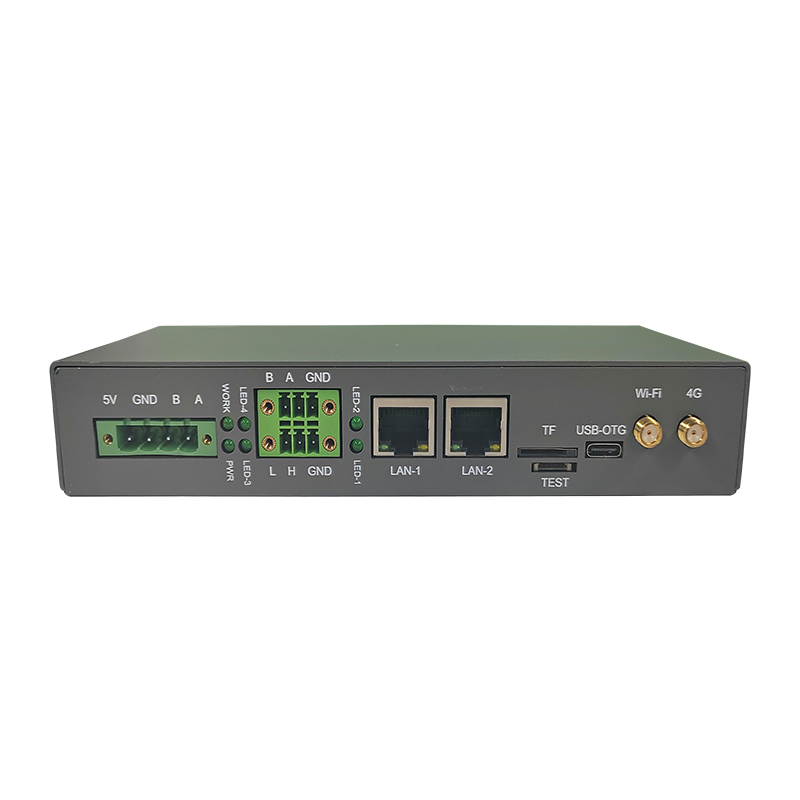
- TV-IS013: two RS-485 ports and one CAN port, two Gigabit Ethernet ports, 4G and Wi-Fi, publishing over MQTT, Modbus, OPC UA or HTTP; −20 to +70 °C.
- TV-RK3568: five RS-485 ports plus CAN on an HMI-class board, useful when the display controller also runs the field bus.
- TV-NUC972: two CAN and two RS-485 ports for entry-level HMIs.
To compare the processors behind these boards, read our RK3568 vs i.MX8M vs AM3354 comparison.
About TouchVision. TouchVision has designed and manufactured industrial touch displays, embedded boards, panel PCs, IoT gateways and edge AI computers since 2012, from standard models to full OEM/ODM projects. Standard products carry a 3-year warranty from delivery. For bespoke builds, see our custom RS-485 and CAN gateway design on the TouchVision OEM/ODM site, or read about us.
Frequently asked questions
Is CAN better than RS-485?
Neither is better in general. CAN is stronger for event-driven, multi-master networks with strict timing; RS-485 is cheaper and simpler for polled devices on long cables.
Can Modbus run over CAN?
Modbus RTU is defined for serial lines such as RS-485. On CAN networks, protocols such as CANopen or J1939 are normally used, and a gateway translates between them and Modbus.
Can RS-485 and CAN share the same cable?
Not on the same pair. They use different signalling and bus access, so each needs its own twisted pair and termination.
How many devices can be on an RS-485 bus?
A standard bus supports 32 unit loads. Transceivers with fractional unit loads allow more, up to 256 devices at one-eighth unit load, subject to cable and protocol limits.
Does a CAN bus need termination?
Yes. A classic high-speed CAN bus is terminated at both physical ends, normally with 120 Ω resistors, and stub lengths must stay within the limits for the bit rate.
Sources and standards referenced
- Texas Instruments SLLA067C: Comparing bus solutions
- CAN in Automation: CANopen lower layers and bit timing
- IGENTEC: Choosing industrial communication, RS485, CAN or Ethernet (Korean)
Need a recommendation for your project?
Send your drawings, quantities and environment through our RFQ form and a TouchVision engineer will reply with a recommended configuration, quotation and sample plan. You can also call or WhatsApp +86 135 0532 6001.