In the LoRa vs NB-IoT choice, LoRa runs on licence-free radio bands, so you can build and own a private network with your own gateways, while NB-IoT rides on a mobile operator’s licensed network and needs a SIM and subscription. Choose LoRa for sites you control and NB-IoT for scattered assets inside good operator coverage.
This guide is written by the engineering team of Beijing Huamei Xuntong Technology Co., Ltd. (TouchVision), a manufacturer founded in 2012 that designs and builds industrial displays, embedded boards, HMI panels, industrial gateways and edge AI computers.
Key takeaways
- LoRa runs in licence-free bands and can be a fully private network; NB-IoT runs on an operator’s licensed LTE network.
- Quoted coverage and throughput are similar; peak current, duty cycle rules and network ownership differ most.
- LoRa must use each region’s frequency plan, such as EU863-870, US902-928 or AU915-928.
- NB-IoT suits scattered assets in good operator coverage; LoRa suits sites you control.
- A hybrid gateway with LoRa plus 4G or NB-IoT uplink often gives the best of both.
What is the difference between LoRa and NB-IoT?
LoRa is a radio modulation used in licence-free sub-GHz bands, usually with the LoRaWAN network protocol, while NB-IoT is a 3GPP cellular standard that operators run inside their licensed LTE spectrum. Both are low-power wide-area network (LPWAN) technologies designed for small, infrequent messages from battery or low-power devices. The practical difference is ownership. With LoRa you can install your own gateways on a plant roof and keep the whole network private. With NB-IoT the network belongs to the operator; you buy SIMs and a data plan, and coverage is whatever the operator has built.
LoRa uses chirp spread spectrum modulation, which tolerates interference and works at very low signal-to-noise ratios. NB-IoT borrows its radio design from LTE, with OFDMA on the downlink and single-carrier FDMA on the uplink, and occupies a narrow 180 kHz carrier.
LoRa vs NB-IoT: how do they compare on coverage, power and data?
On paper the two are close on coverage and throughput; the bigger differences are in spectrum rules, peak current and who controls the network. The figures below come from a comparison published by the LoRa Alliance with ABI Research, so treat them as a starting point and confirm with your own module datasheets and site tests.
| Factor | LoRaWAN | NB-IoT |
|---|---|---|
| Spectrum | Unlicensed spectrum in sub-GHz ISM bands, with duty cycle or dwell-time rules | Licensed LTE spectrum, no duty cycle limit |
| Channel bandwidth | 125 kHz | 180 kHz |
| Quoted coupling loss | 165 dB | 164 dB (varies by device class) |
| Quoted peak current | 32 mA | 120 mA |
| Network | Private, public or hybrid | Operator network only |
| Running cost | Your gateways and backhaul | SIM and data subscription per device |
| Best fit | Campus, plant, farm, building | Scattered assets in operator coverage |
NB-IoT handles frequent messaging better because it is not bound by the duty cycle limits that apply in licence-free bands. LoRa’s lower peak current is easier on small batteries. Either way, battery life in the field depends far more on how often a device transmits and how strong its signal is than on headline figures.
Which LoRa frequency plan applies in each region?
LoRa devices must use the regional frequency plan of the country where they operate, so a 915 MHz device built for the Americas cannot simply be installed in Europe. The Things Network keeps a country list of plans and their regulatory documents:
- Europe and the UK: EU863-870 (often called EU868), under CEPT Recommendation 70-03.
- United States and Canada: US902-928 (often called US915).
- Australia, Brazil, Argentina and Chile: AU915-928.
- China: CN470-510.
- South Korea: KR920-923; India: IN865-867.
- Much of Southeast Asia: AS923 variants.
Specify the region before you order radios, gateways or antennas, and check the local regulator’s current rules for anything not covered by a standard plan.
When should you choose NB-IoT over LoRa?
Choose NB-IoT when devices are spread across a city or a country, sit inside good operator coverage and nobody wants to install or maintain gateways. Typical examples are utility meters in many separate buildings, roadside equipment and assets that move between sites. Before you commit, check the operator’s live coverage at the real install points, including basements and metal cabinets. The GSMA keeps a map of operators that have commercially launched NB-IoT and LTE-M, which helps you see which technology is actually offered in each country. Also check the operator’s long-term plans: in the UK, Ofcom reports that 3G is already off and 2G will end by 2033, a reminder that cellular technologies have a lifetime that you do not control.
When is LoRa the better choice?
LoRa is usually the better choice when all devices are on a site you control, such as a factory, mine, farm, port or energy storage plant, and you want no per-device subscription and full control of the data path. A handful of gateways can cover a large site, and data never has to leave your network. LoRa also helps where operator coverage is weak or absent. The trade-offs are that you must design, install and maintain the gateways, respect duty cycle rules, and plan backhaul from the gateways to your server.
Many projects end up hybrid: LoRa sensors around the site, and a gateway that sends the collected data upstream over Ethernet, 4G LTE or NB-IoT. That hybrid often settles the LoRa vs NB-IoT question without picking only one. Protocol conversion on that gateway is covered in our Modbus to MQTT step-by-step guide.
LoRa vs NB-IoT decision checklist
- Site: one site you control, or many scattered locations?
- Coverage: measured operator signal at real install points, or the option of your own gateways?
- Traffic: message size and interval; frequent messaging favours licensed spectrum.
- Power: battery or mains, target lifetime, peak current the battery can deliver.
- Region: LoRa frequency plan per country; NB-IoT bands and operator availability.
- Cost: gateways and maintenance versus per-device subscriptions over the project life.
- Data ownership: private network requirement or acceptance of operator transport.
- Backhaul and protocols: Ethernet, 4G or NB-IoT uplink; Modbus, MQTT or OPC UA to the server.
Which TouchVision gateways cover both sides of LoRa vs NB-IoT?
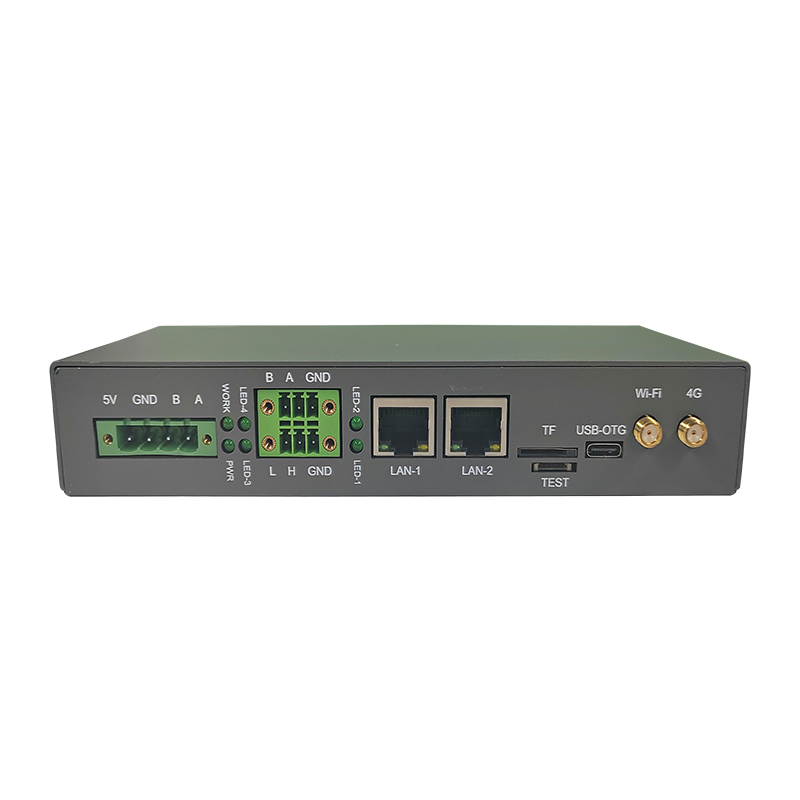
The TouchVision TV-W-GYWG gateway offers both a 915 MHz LoRa radio and NB-IoT, alongside 4G and Ethernet, so one device can collect field data and choose the uplink that fits the site. The TV-W-GYWG multi-protocol gateway reads two CAN buses with J1939, two RS-485 ports and two 4–20 mA inputs, encrypts its LoRa link with AES-128 for roughly 1.2 km in open field, acts as a Modbus TCP server for up to 16 clients, and runs from 18–36 V DC over -25 to +85 °C. LoRaWAN operation and other regional bands are confirmed per project. Where a site has 4G or Wi-Fi instead, the TV-IS013 industrial IoT gateway publishes field data over MQTT or OPC UA. For selection steps see how to choose an industrial IoT gateway and RS-485 vs CAN bus, and for energy sites see our power automation and energy storage page.
About TouchVision. TouchVision has designed and manufactured industrial touch displays, embedded boards, panel PCs, IoT gateways and edge AI computers since 2012, from standard models to full OEM/ODM projects. Standard products carry a 3-year warranty from delivery. For bespoke builds, see our custom industrial IoT gateway service on the TouchVision OEM/ODM site, or read about us.
Frequently asked questions
Is LoRa better than NB-IoT?
Neither is better in general. LoRa suits private networks on sites you control without subscriptions; NB-IoT suits scattered devices inside good operator coverage with no gateways to maintain.
Does NB-IoT need a SIM card?
Yes. NB-IoT is a cellular technology, so each device needs a SIM or eSIM and a data plan from an operator that has launched NB-IoT in that country.
Which has longer battery life, LoRa or NB-IoT?
Industry comparisons quote lower peak current for LoRa, but real battery life depends mostly on message frequency, payload size and signal strength at the install point.
Can a 915 MHz LoRa device be used in Europe?
No. Europe and the UK use the EU863-870 plan, so the radio, antenna and firmware must match that plan; 915 MHz plans are used in the Americas and parts of Asia-Pacific.
Does TouchVision have a gateway with both LoRa and NB-IoT?
Yes. The TV-W-GYWG supports 915 MHz LoRa with AES-128, NB-IoT, 4G and Ethernet; LoRaWAN operation and other bands are confirmed per project.
Sources and standards referenced
- The Things Network (Netherlands): LoRaWAN frequency plans by country
- LoRa Alliance and ABI Research (US): LoRaWAN and NB-IoT, competitors or complementary?
- GSMA (UK): Mobile IoT deployment map for NB-IoT and LTE-M
- Ofcom (UK): switching off 2G and 3G mobile networks
Need a recommendation for your project?
Send your drawings, quantities and environment through our RFQ form and a TouchVision engineer will reply with a recommended configuration, quotation and sample plan. You can also call or WhatsApp +86 135 0532 6001.