How does a custom touch screen project work? It normally moves through six stages: requirements, proposal and quote, engineering samples, design iteration, a pilot batch and mass production. Most of the cost and schedule risk is decided in the first two stages, so a clear written specification and early drawing review matter most.
This guide is written by the engineering team of Beijing Huamei Xuntong Technology Co., Ltd. (TouchVision), a manufacturer founded in 2012 that designs and builds industrial displays, embedded boards, HMI panels, industrial gateways and edge AI computers.
Key takeaways
- Custom display projects pass through six gates: requirements, quote, samples, iteration, pilot and mass production.
- Changing only glass, mechanics and connectors (OEM or semi-custom) is faster and cheaper than a new ODM design.
- Cost splits into one-time engineering and tooling plus unit price; reuse of proven parts lowers both.
- Test samples in the real enclosure and environment, and freeze an approved reference sample before production.
- A complete request package (volumes, environment, interfaces, drawings) produces an accurate first quote.
When does a custom touch screen make sense?
A custom touch screen makes sense when no catalogue display fits your enclosure, environment or interface without compromise, or when you need a part that stays unchanged for many years. Typical triggers are an unusual size or outline, outdoor brightness, a specific glass or cover lens, or a controller board that needs a particular video interface.
Customisation is not all-or-nothing. Many projects start from a proven display and change only the parts that touch the customer’s design: the cover glass, the bracket, the cable exit and the connector. That approach, often called a semi-custom display, keeps most of the validated design and shortens the schedule. A fully new design is justified when the volume, the lifecycle or the mechanical constraints make a standard platform impractical.
What can be customised on a touch display?
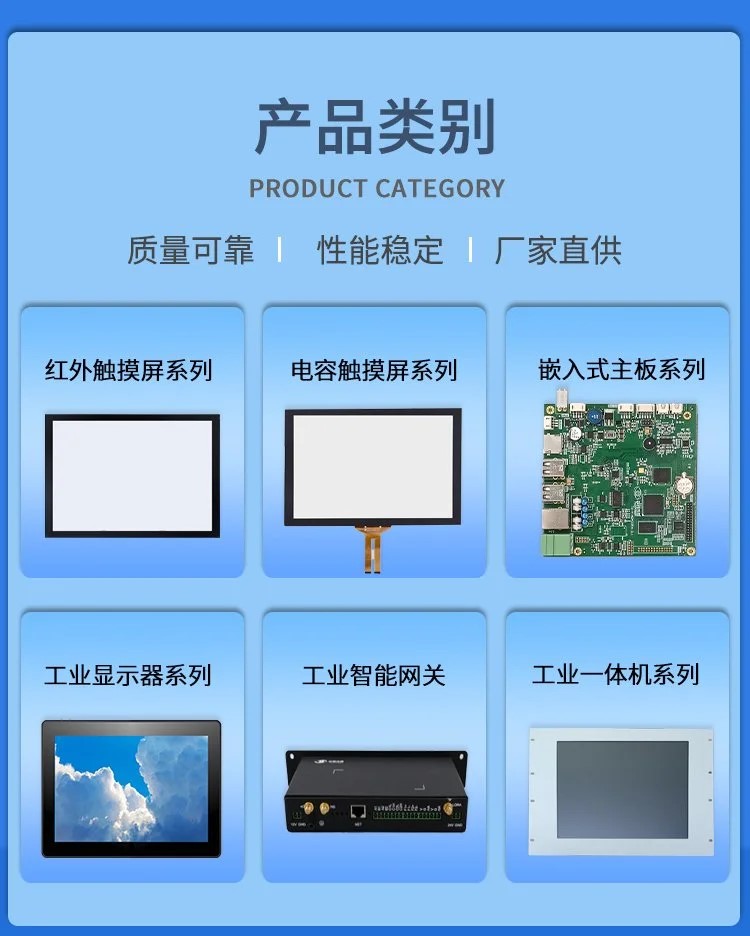
Almost every layer of a touch display can be changed, from the LCD and backlight to the touch sensor, cover glass, frame and electronics. The table groups the options buyers ask about most.
| Layer | Typical options | Questions to answer |
|---|---|---|
| LCD panel | Size, aspect ratio, resolution, brightness | Indoor or outdoor? How long must the panel stay in production? |
| Touch | PCAP, infrared, resistive or no touch | Gloves, water, stylus, multi-touch? |
| Custom cover glass | Thickness, toughening, AG/AR treatment, printed border, logo, shape | Impact risk, cleaning chemicals, branding? |
| Optical stack | Air gap or optical bonding | Sunlight, condensation, vibration? |
| Mechanics | Bezel, frame, brackets, mounting holes, cable exit | Open frame, panel mount, VESA? Existing drawing to match? |
| Electronics | Video interface (LVDS, eDP, HDMI, MIPI), touch output, controller board | Which host board and operating system? |
| Environment | Front IP rating, operating temperature | Wash-down, outdoor, cold start? |
TouchVision adjusts these items for its industrial touch monitors and can deliver the display together with an embedded board such as the TV-RK3568 or TV-AM3354 as a tested HMI module. If you are still deciding the mounting style, compare open frame vs panel mount touch monitors.
OEM vs ODM: what is the difference for a touch display?
OEM means the manufacturer supplies one of its existing products, modified and branded for you. ODM means the manufacturer designs a new product to your specification and then builds it. Both are common in industrial displays, and many projects sit somewhere in between. An ODM touch display suits programmes that need a new outline or new electronics.
OEM is faster and carries less risk because the electronics and touch design are already field-proven. ODM gives you full control of the form factor and features but needs more engineering time, more samples and usually a one-time engineering charge. A useful rule: if your requirement can be met by changing glass, mechanics and connectors, ask for OEM first. If the outline, electronics or interfaces must all change, plan for ODM.
How does a custom touch screen project run, step by step?
A well-run project follows a fixed sequence of gates, and each gate has something to approve before money and time are committed to the next one. TouchVision runs custom work in six stages.
- Requirements. You send drawings, the part to replace or a written description. An engineer reviews feasibility. For sample requests TouchVision usually replies within one working day.
- Proposal and quotation. The supplier recommends a configuration, flags risks and quotes unit price, any one-time engineering cost and lead time. This is where a design-for-manufacturability review should happen.
- Engineering samples. Samples are built for fit, function and environmental testing in your real enclosure.
- Iteration. Mechanical, electrical and firmware changes are made based on your test results, then re-sampled if needed.
- Pilot batch. A small run on the production line confirms yield, assembly method and test coverage. TouchVision builds pilots on its ISO 9001 lines.
- Mass production and lifecycle. Scheduled deliveries begin, with change notification and long-term availability for the approved configuration.
What drives the cost of a custom touch display?
The price of a custom display has two parts: one-time engineering and tooling cost, and the recurring unit price, and both depend mostly on how many layers you change.
- One-time cost covers engineering hours plus any new tooling, such as cover glass printing screens, a new FPC or a new metal frame. Reusing existing glass, sensors and frames reduces or removes it.
- Unit price follows the bill of materials: panel size and brightness, touch type, glass treatment, bonding and the controller board.
- Quantity spreads the one-time cost and affects material pricing. TouchVision supports small-batch pilot orders, so a small MOQ is possible, and the exact minimum depends on how much is customised.
- Late design changes after samples are approved are the most expensive cost driver, because they can mean new tooling and repeated testing.
What should you check at the sample stage?
The sample stage exists to find problems while they are still cheap, so test the sample in your real product and under your worst real conditions. Before paying for tooling, agree what the sample must prove.
- Does the outline, mounting and cable exit match the enclosure drawing?
- Does touch work with your gloves, water exposure and cover thickness?
- Is brightness and readability acceptable at the real site light level?
- Does the display start and run across your temperature range?
- Does it pass the EMC and safety checks your product needs?
- Which approved sample becomes the reference for production, and how will later changes be notified?
In automotive and other regulated supply chains, a formal production part approval process plays this role. Smaller projects can borrow the same idea: sign off one approved reference sample and agree a written specification against it.
What information speeds up a quote?
A complete request package lets the supplier quote accurately the first time and avoids weeks of back-and-forth. Include as many of these as you can.
- Application, target market and required certifications
- Annual volume and first-order quantity
- Screen size, touch type, brightness and interface
- Host board or operating system
- Environment: temperature, outdoor exposure, IP rating
- Drawings or photos of the current part, if replacing one
- Target price and launch date
Why choose TouchVision as your custom touch display manufacturer?
TouchVision has made infrared touch screens and industrial touch monitors since 2012 and designs the boards, firmware and HMI software that drive them, so one engineering team covers the whole interface.
As an OEM touch screen manufacturer, TouchVision reuses proven core boards and touch designs in custom projects to reduce risk. TouchVision can match the outline and mounting holes of an existing display to act as a drop-in second source, and develops BSPs, drivers, firmware and HMI screens. The company holds ISO 9001, ISO 14001 and ISO 45001 certification. Start with the OEM/ODM customisation page, read the step-by-step customisation process, or send your requirements through the contact form.
About TouchVision. TouchVision has designed and manufactured industrial touch displays, embedded boards, panel PCs, IoT gateways and edge AI computers since 2012, from standard models to full OEM/ODM projects. Standard products carry a 3-year warranty from delivery. For bespoke builds, see our custom touch screen display service on the TouchVision OEM/ODM site, or read about us.
Frequently asked questions
How long does a custom touch screen project take?
It depends on how much changes. A semi-custom display that reuses a proven panel and touch sensor moves much faster than a new ODM design that needs new tooling and several sample rounds. The supplier should give a lead time with the quotation.
What is the minimum order quantity for a custom touch display?
There is no single figure. TouchVision supports small-batch pilot orders, and the minimum depends on which parts are customised and whether new tooling is needed.
Can a manufacturer copy the size of the display I use today?
Yes. TouchVision can match the outline, mounting holes and connector positions of an existing display so its part drops into your current design as a second source.
What is a one-time engineering cost?
It is a single charge for design work and any new tooling, such as a new cover glass print or frame. It is quoted separately from the unit price and is often reduced when existing parts are reused.
Do custom displays come with software and drivers?
TouchVision develops BSPs, drivers, firmware and HMI screens for its hardware, and can deliver a display with an embedded board and operating system image installed.
Sources and standards referenced
Need a recommendation for your project?
Send your drawings, quantities and environment through our RFQ form and a TouchVision engineer will reply with a recommended configuration, quotation and sample plan. You can also call or WhatsApp +86 135 0532 6001.