AI fire and smoke detection uses video analytics on camera streams to recognise the shape, movement and spread of smoke or flame, often seconds after it becomes visible. It helps most in large, tall or semi-open spaces where ceiling detectors react late, but it supplements listed fire detection rather than replacing it unless a performance-based design approves it.
This guide is written by the engineering team of Beijing Huamei Xuntong Technology Co., Ltd. (TouchVision), a manufacturer founded in 2012 that designs and builds industrial displays, embedded boards, HMI panels, industrial gateways and edge AI computers.
Key takeaways
- AI fire and smoke detection finds visible smoke or flame in camera images instead of waiting for particles or heat at a sensor.
- It helps most in high-ceiling warehouse, semi-open and outdoor spaces where ceiling detectors react late.
- NFPA 72 accepts video image detection only under a performance-based design; VdS 3847 gives a German test procedure.
- General-purpose AI boxes are a supplementary early-warning layer, not a replacement for listed detectors.
- Camera placement, masks, persistence time and night-time testing decide the false-alarm rate.
What is AI fire and smoke detection?
AI fire and smoke detection is the use of trained video analytics to find visible smoke or flame in camera images and raise an alert, without waiting for smoke particles or heat to reach a sensor. Fire engineers have used the older term video image detection for years: video image smoke detection (VISD) and video image flame detection (VIFD). Newer systems apply deep learning models to the same task, which improves recognition across different scenes but does not change the basic principle. The camera has to see the smoke or flame, and the scene has to be lit well enough for the model to work.
Specialist consultancies note that these systems are used mostly in critical or unusual spaces: power generation, warehouses, tunnels, aircraft hangars, manufacturing halls and heritage buildings where visible detectors spoil the interior. Many sites now also want the same capability for battery storage rooms and EV charging areas.
How does camera-based smoke and flame detection work?
The analytics compare successive video frames, isolate regions that move and change like smoke or flicker like flame, and pass those regions to a trained classifier that rejects lookalikes before an alarm is raised.
- Motion and texture: smoke drifts, spreads and lowers contrast in the area behind it, while flame flickers at characteristic rates and shows bright, saturated colour.
- Classification: a neural network scores each candidate region. One Japanese imaging company describes combining a signal-processing step, borrowed from its gas-imaging cameras, that visualises the fluctuation of smoke with an AI stage whose main job is to suppress false alarms.
- Persistence: most systems require the event to persist for a set time or across several frames before alarming. A Japanese vendor of video fire monitoring advertises detection of flame or smoke in as little as 8 seconds, with AI used to tell production heat sources such as burners and furnaces from a real fire.
- Location: because the alert comes with an image, the operator sees where the event started, which speeds up the first response.
Where does AI smoke detection help most?
Video-based detection adds the most value where smoke dilutes or stratifies before reaching ceiling detectors, where the space is semi-open, or where the hazard is spread over a wide area that a camera can see in one view.
| Site | Why spot detectors struggle | What video analytics adds |
|---|---|---|
| High-ceiling warehouse and logistics halls | Smoke cools and spreads before reaching the roof | Sees smoke near its source, at rack level |
| Semi-open sheds, loading bays and car parks | Airflow carries smoke away from detectors | Covers the open area from one or two cameras |
| EV charging bays and battery rooms | An EV charging fire can develop fast, often unattended | Early visual alert linked to the charger site |
| Recycling and waste yards | Outdoor piles, no ceiling at all | Watches piles for smoke at the surface |
| Heritage buildings and atria | Detectors are hard to fit or unwanted | Uses cameras placed out of sight |
Policy is moving the same way in some markets. In South Korea, the environment ministry’s 2025 EV charger subsidy guidelines made CCTV or thermal cameras that watch charging bays for fire eligible for subsidy, provided they are dedicated to fire monitoring of the charging area. Our edge vs cloud video analytics guide explains why this kind of alarm is usually processed on site.
Does AI fire detection replace smoke detectors?
No, not by default: in most jurisdictions camera analytics are a supplementary layer, and it can only count as part of the code-required fire alarm system when a listed video detection system is designed, approved and maintained under the relevant code.
- United States: NFPA 72 recognises video image smoke and flame detection, but requires a performance-based design. Video signals may only be shared with other systems through outputs provided by the manufacturer, software must be protected against unauthorised change, and inspection, testing and maintenance follow the manufacturer’s published instructions.
- Germany: VdS published guideline VdS 3847 for video camera equipment used for visual fire monitoring, giving insurers and operators a test procedure to judge the reliability of such systems. The guideline grew out of an innovation test of a commercial video fire detection product.
- Japan: a major vendor states openly that its AI smoke detection application is not fire equipment as defined for smoke detectors under the Fire Service Act; it is sold as an additional early-warning tool.
Treat a general-purpose AI box with a fire and smoke algorithm as a monitoring and early-warning tool. Keep the listed detectors, sprinklers and fire alarm control panel that the code requires, and link the analytics to people and procedures rather than to automatic extinguishing.
What causes false alarms, and how do you reduce them?
Most false alarms come from things that look like smoke or flame on camera: steam, dust, fog, exhaust, headlights, reflections, welding and sunlight on moving surfaces. Reduce them with a few practical steps:
- Place cameras so the hazard fills a reasonable part of the image and the background is stable.
- Mask areas with known steam, exhaust or process flames, and schedule masks for planned hot work.
- Choose a persistence time that balances speed and nuisance alarms, and tune it per camera.
- Check performance at night and in changing light; consultants warn that ambient lighting, airflow and changes in how the building is used all affect reliability.
- Log every alert with its image for the first weeks, then retune.
Video smoke detection setup checklist
- Role: agree in writing whether the system is supplementary or part of an approved design.
- Cameras: resolution, lens and position for each zone; day and night image quality.
- Streams: RTSP or ONVIF access, frame rate and substream settings on the NVR or cameras.
- Compute: number of channels analysed at once and spare capacity for other algorithms.
- Alarm path: on-screen pop-up, VMS or API event, an alarm output relay to a beacon, and who responds.
- Integration: fire alarm control panel or building management link only through approved interfaces.
- Tuning: masks, persistence time and sensitivity per camera, reviewed after a trial period.
- Maintenance: lens cleaning, model updates and periodic test with approved smoke sources.
Which TouchVision hardware runs fire and smoke analytics?
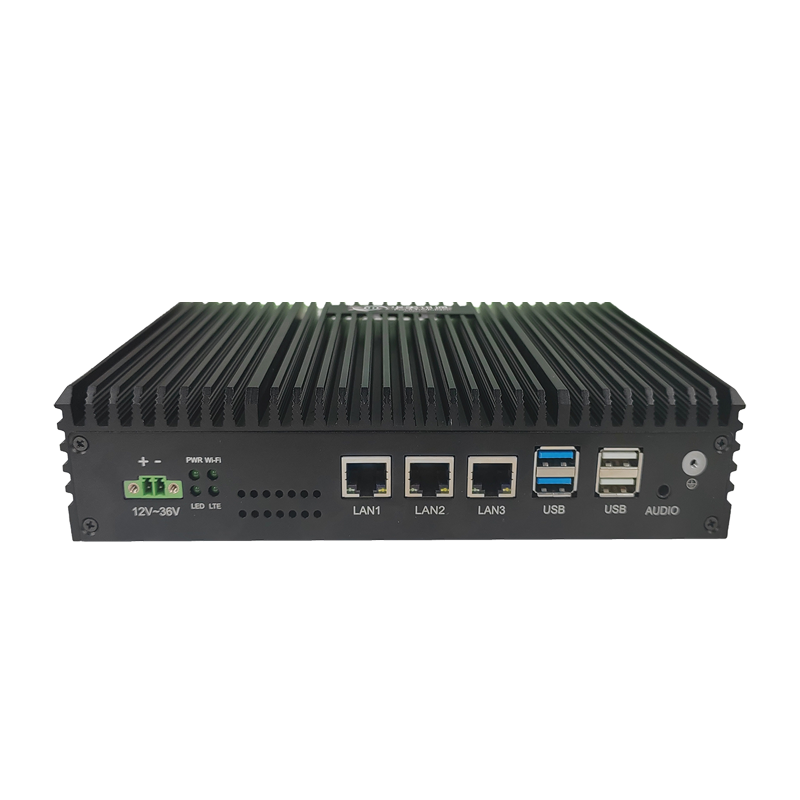
TouchVision’s edge AI boxes run fire and smoke detection among more than 50 algorithms on streams from existing cameras, and send alerts to a VMS, an API, a local display or a digital output; compliance of a complete fire-alarm system remains the system maker’s responsibility. The YZ-B011 AI video analytics box uses a SOPHGO BM1684 with 17.6 TOPS INT8, analyses 16 HD streams at once and has opto-isolated digital inputs and outputs for alarm linkage. The YZ-B016 runs directly from 220 V AC with two alarm inputs and two RS-485 ports, and the YZ-B013 is a 12 V box rated for -20 to +70 °C. For a control room view, alerts can be shown on the security and fire-safety all-in-one terminal. Sizing advice is in how many cameras an edge AI box can handle, and related use cases are on our fire safety and building control page.
About TouchVision. TouchVision has designed and manufactured industrial touch displays, embedded boards, panel PCs, IoT gateways and edge AI computers since 2012, from standard models to full OEM/ODM projects. Standard products carry a 3-year warranty from delivery. For bespoke builds, see our OEM/ODM engineering services on the TouchVision OEM/ODM site, or read about us.
Frequently asked questions
Can AI cameras replace smoke detectors?
Not by default. Codes such as NFPA 72 accept video image detection only as a listed system under a performance-based design. A general AI box should run alongside the required detectors as an early-warning layer.
How fast is AI smoke detection?
It depends on the scene and settings. Vendors quote detection in seconds once smoke is visible, for example as little as 8 seconds, but real speed depends on camera view, lighting and the persistence time you set.
Can I use my existing CCTV cameras for fire detection?
Often yes. Many systems analyse ordinary visible-light camera streams over RTSP or ONVIF, but each camera’s position, resolution and night performance should be checked for the zone it covers.
What causes false alarms in video smoke detection?
Steam, dust, fog, vehicle exhaust, headlights, reflections and welding are common causes. Masks, tuned persistence time and careful camera placement reduce them.
Is AI fire detection useful for EV charging areas?
Yes, as an early visual alert for often unattended bays. In South Korea, fire-monitoring cameras dedicated to charging areas became eligible for charger subsidies in 2025.
Does TouchVision certify fire alarm systems?
No. TouchVision supplies edge AI boxes and display terminals with component documentation; certification of a complete fire-alarm system under EN 54, UL 864 or local codes is the system maker’s responsibility.
Sources and standards referenced
- Jensen Hughes (US): what’s the deal with video image detection
- UpCodes (US): NFPA 72 section 17.7.8, video image smoke detection
- VdS (Germany, German): new VdS guidelines, VdS 3847 video camera equipment for visual fire monitoring
- Konica Minolta (Japan, Japanese): FORXAI smoke detection using image recognition AI
- VFD (Japan, Japanese): FSDS video fire monitoring system
- Yonhap News (South Korea, Korean): state subsidy for fire-monitoring CCTV at EV chargers
- Semaphor Systems (US): AI fire and smoke detection cameras guide
Need a recommendation for your project?
Send your drawings, quantities and environment through our RFQ form and a TouchVision engineer will reply with a recommended configuration, quotation and sample plan. You can also call or WhatsApp +86 135 0532 6001.