Fuel dispenser display requirements come from two sides. The dispenser as a whole must meet hazardous-area rules such as ATEX, IECEx, NEC Article 514 or Inmetro, which decide where electronics may sit. The display itself must stay readable in sunlight, work with gloves, survive outdoor temperatures and talk to the dispenser controller reliably.
This guide is written by the engineering team of Beijing Huamei Xuntong Technology Co., Ltd. (TouchVision), a manufacturer founded in 2012 that designs and builds industrial displays, embedded boards, HMI panels, industrial gateways and edge AI computers.
Key takeaways
- The dispenser maker certifies the complete dispenser for its hazardous area; display suppliers provide components and documentation.
- Frameworks differ by market: ATEX and EN 13617-1 in the EU, IECEx internationally, NEC Article 514 in the US, Inmetro in Brazil.
- Where the electronics sit relative to vapour barriers and classified zones is the central design decision.
- Outdoor readability, glove-friendly touch and wide-temperature fanless controllers are the core display requirements.
- TouchVision’s AM3354 boards offer up to 5× RS-485, LVDS with backlight drive and -20 to +85 °C operation.
Who is responsible for hazardous-area compliance in a fuel dispenser?
The dispenser manufacturer is responsible for certifying the complete dispenser for its hazardous area; the display and controller supplier provides components and documentation that fit the manufacturer’s protection concept. This split shapes every other part of the fuel dispenser display requirements.
A fuel dispenser contains hydraulics, meters and nozzles that can release flammable vapour, so part of the cabinet and the area around it is classified as hazardous. The rules depend on the market:
| Market | Main framework | What it covers |
|---|---|---|
| European Union | ATEX Directive 2014/34/EU, applicable since 20 April 2016; EN 13617-1 for dispensers | Equipment for potentially explosive atmospheres; safety requirements for dispenser construction |
| International | IECEx scheme based on IEC standards | Certification of Ex equipment, service facilities and personnel |
| United States | NFPA 70 (NEC) Article 514, Motor Fuel Dispensing Facilities | Classified locations and wiring around dispensers |
| Brazil | Inmetro conformity assessment, Portaria Inmetro nº 115 of 21 March 2022 | Certification rules and conformity seal for Ex electrical equipment |
TouchVision does not supply Ex-certified displays. Its boards and touch screens are components; hazardous-area certification of the complete dispenser stays with the dispenser maker, and TouchVision supports the documentation for its parts.
Where can the display and electronics sit in a dispenser?
The position of the electronics relative to the classified zones is the key design decision: EN 13617-1 uses vapour barriers, sealing systems that limit the extent of hazardous areas inside the dispenser, and classifies barrier types in an annex. The display head is typically designed so that the electronics sit where the protection concept allows.
In the US, NEC Table 514.3(B)(1) classifies the area up to 18 inches (450 mm) above grade within 20 feet (6 m) horizontally of the dispenser enclosure as Class I, Division 2, with stricter classification inside the dispenser enclosure. US installers also apply the 514 rules on emergency disconnects and the bonding requirements of Article 501. For the display designer, the practical outcome is the same in every market: agree the mounting position, cable routing and sealing with the dispenser’s Ex engineer before choosing parts.
What makes a fuel dispenser display readable outdoors?
Forecourt screens face direct sun, rain and night use, so brightness, glass treatment and contrast matter more than resolution.
- Brightness: choose a high-brightness or sunlight-readable panel for canopies open to the sky; see our sunlight-readable display guide.
- Glass: toughened cover glass with anti-glare treatment resists impact and reflections.
- Automatic dimming: lower brightness at night saves power and avoids glare for drivers.
- Simple UI: large digits for volume and price, and high-contrast buttons for payment and grade selection.
Which touch technology suits a forecourt HMI?
Infrared touch works with gloves and through rain drops better than many capacitive designs, while PCAP gives a flat sealed front; many forecourt HMIs use physical keys alongside the screen for payment entry.
| Option | Strengths | Watch out for |
|---|---|---|
| Infrared touch frame with toughened glass | Any object works, including gloves; glass can be thick | Raised bezel can collect dirt; direct sun on the sensors must be tested |
| PCAP behind cover glass | Flat, easy-to-clean front; multi-touch | Glove and water tuning; thick glass needs a strong controller |
| Display with physical keypad | Tactile entry for PIN and amounts | Key sealing and wear |
Accessibility also applies at the pump. The US 2010 ADA Standards require at least one fuel dispenser of each type to have operable parts that meet the reach and one-hand rules of section 309, though fuel nozzles are exempt from the 5-pound operating force limit. Our infrared vs capacitive comparison covers touch choice in more detail.
What should the dispenser display controller board provide?
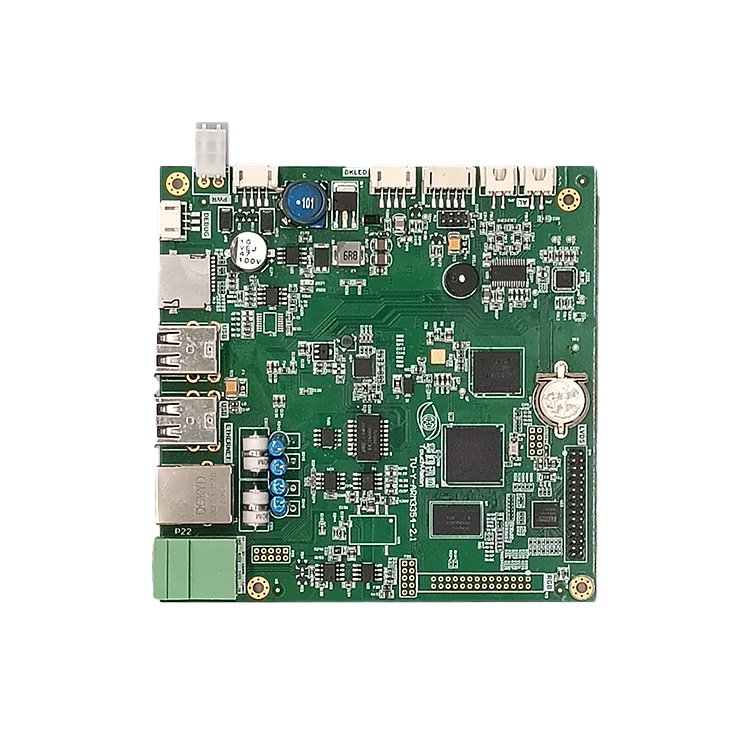
A dispenser controller must drive the panel, talk to the pump electronics and payment devices, and run for years without a fan. A fuel dispenser controller board should meet these typical requirements; here is how TouchVision’s AM3354 boards compare:
| Requirement | Why it matters | TouchVision example |
|---|---|---|
| Fanless, low power | No air intake in a sealed head; less heat | TI Sitara AM3354 Cortex-A8 boards |
| Wide operating temperature | Sun-loaded cabinets and cold mornings | -20 to +85 °C rated boards |
| Serial ports | Pump controller, meters, payment and display links | TV-AM3354 with 5× RS-485; 2-in-1 Version B with 5× RS-485 |
| Display interface | Direct panel connection with backlight drive | 2-in-1 board: single/dual LVDS and RGB with onboard LED backlight driver |
| Reliability | Unattended operation | Watchdog and RTC on the TV-AM3354 |
| Software | Long-term maintainable UI | Linux + Qt |
Smart fuel dispensers are among the listed applications of the TV-AM3354, and fuel dispenser displays are among those of the 2-in-1 board. For a comparison of ARM boards, see RK3568 vs i.MX8M vs AM3354; for panel interfaces, see LVDS vs eDP vs MIPI DSI.
What about safety monitoring across the forecourt?
Beyond the dispenser itself, station operators increasingly add AI video analytics to spot unsafe behaviour, using cameras mounted outside the dispenser. TouchVision’s edge AI boxes include a fuel station scenario pack that detects smoking and phone calls on the forecourt, unremoved nozzles, missing anti-static clothing, unloading procedure violations, missing fire extinguishers and absent staff, with analysis running locally. See fuel dispenser displays and forecourt AI for the full set.
Fuel dispenser display requirements checklist
- Compliance owner: dispenser maker’s Ex engineer confirms the protection concept and target markets (ATEX, IECEx, NEC 514, Inmetro).
- Position: display and electronics location relative to vapour barriers and classified zones agreed.
- Documentation: component drawings, materials and electrical data supplied for the certification file.
- Readability: brightness, anti-glare glass and night dimming tested on a real canopy.
- Touch: infrared touch screen, PCAP or keypad chosen and tested with gloves and rain.
- Controller: fanless, wide temperature, enough RS-485 ports, LVDS and backlight drive.
- Accessibility: operable parts within reach ranges for US sites.
- Lifecycle: long-term supply of the panel and board confirmed.
About TouchVision. TouchVision has designed and manufactured industrial touch displays, embedded boards, panel PCs, IoT gateways and edge AI computers since 2012, from standard models to full OEM/ODM projects. Standard products carry a 3-year warranty from delivery. For bespoke builds, see our custom dispenser controller boards on the TouchVision OEM/ODM site, or read about us.
Frequently asked questions
Does a fuel dispenser display need ATEX certification?
The complete dispenser needs certification for its hazardous area in the EU. Whether the display itself needs Ex protection depends on where it sits in the dispenser’s protection concept, which the dispenser maker defines.
What is the hazardous area around a fuel dispenser in the US?
Under NEC Table 514.3(B)(1), the area up to 18 inches above grade within 20 feet of the dispenser enclosure is Class I, Division 2, with stricter classification inside the dispenser enclosure.
Which standard covers fuel dispenser construction in Europe?
EN 13617-1 sets safety requirements for the construction and performance of fuel dispensers and supports the ATEX and Machinery directives.
What touch screen works best on a fuel dispenser?
Infrared touch behind toughened glass works with gloves, while PCAP gives a flat sealed front. Either must be tested in sun and rain on the real dispenser.
Are TouchVision displays Ex-certified?
No. TouchVision supplies boards and touch screens as components and supports the dispenser maker’s certification documentation.
Sources and standards referenced
- European Commission: Equipment for potentially explosive atmospheres (ATEX)
- iTeh Standards: EN 13617-1:2021 Petrol filling stations, Part 1: Safety requirements for fuel dispensers
- IECEx: IEC System for Certification to Standards Relating to Equipment for Use in Explosive Atmospheres
- IAEI Magazine: Hazardous (classified) locations, NEC Articles 500 through 517
- Inmetro (Brazil): Certification of electrical equipment for explosive atmospheres (Portuguese)
- U.S. Access Board: 2010 ADA Standards (sections 228 and 309)
Need a recommendation for your project?
Send your drawings, quantities and environment through our RFQ form and a TouchVision engineer will reply with a recommended configuration, quotation and sample plan. You can also call or WhatsApp +86 135 0532 6001.