Which embedded board should an industrial HMI use? Choose the RK3568 for rich graphics, several displays and many serial ports; an i.MX 8M family board when long NXP supply and a real-time core matter; the AM3354 for low-power, long-life controllers with simple screens; and an ARM9 NUC972 board for the lowest-cost basic HMI.
This guide is written by the engineering team of Beijing Huamei Xuntong Technology Co., Ltd. (TouchVision), a manufacturer founded in 2012 that designs and builds industrial displays, embedded boards, HMI panels, industrial gateways and edge AI computers.
Key takeaways
- Define displays, serial I/O, real-time needs, OS and supply period before comparing processors.
- RK3568 boards suit multi-display, graphics-rich HMIs; i.MX 8M family boards suit long-life designs that need a real-time core.
- The AM3354 remains a low-power choice for chargers, dispensers and controllers with simple screens.
- ARM9 boards such as the NUC972 still make sense for low-cost HMIs with CAN and RS-485.
- Confirm the exact SoC part number and the board maker’s longevity and BSP commitments in writing.
What should you compare first when choosing an embedded board?
Compare the job the embedded board must do (graphics, I/O, real-time control, AI) before comparing processors, because the cheapest board that does the job for the full product life is usually the right one. A processor that is twice as fast does not help if it lacks a native display output or a long supply commitment.
For HMIs, kiosks, chargers and controllers, five questions narrow the field quickly:
- How many displays, at what resolution, and over which interface (LVDS, eDP, HDMI, RGB)?
- How many RS-485 ports, CAN buses and Ethernet links does the machine need, and do any need isolation?
- Is there a hard real-time task, such as motor or safety interlock timing, that should not depend on Linux scheduling?
- Which operating system and UI framework will the software team use: Linux with Qt, Android, or an RTOS?
- How many years must the same board be buildable, and can the design tolerate a processor change mid-life?
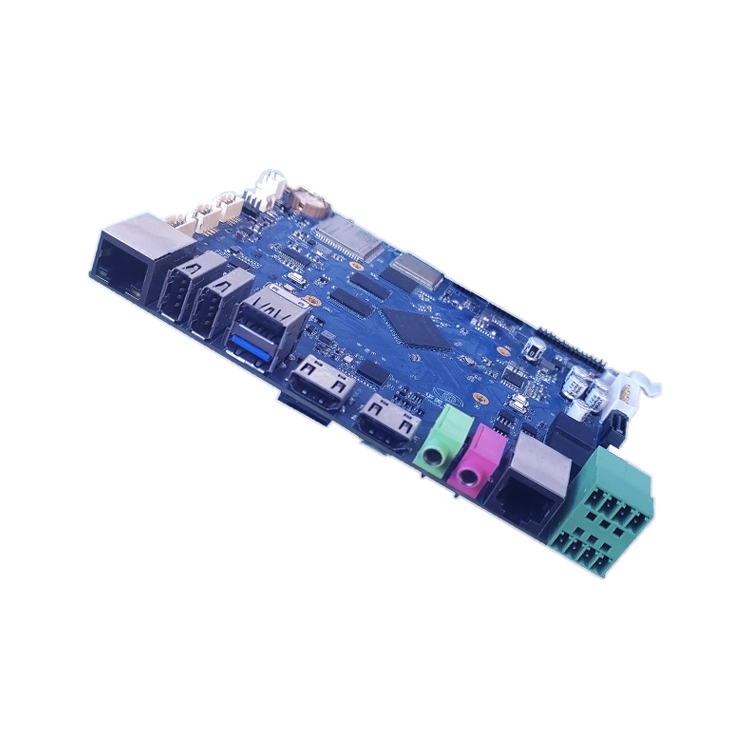
How do RK3568, i.MX 8M, AM3354 and NUC972 compare?
The four platforms cover four price and capability tiers, from a modern quad-core Cortex-A55 with a GPU down to a 300 MHz ARM9 with encryption. The table summarises vendor-level processor traits and the configuration of TouchVision’s boards built on each.
| Item | Rockchip RK3568 | NXP i.MX 8M family | TI Sitara AM3354 | Nuvoton NUC972 |
|---|---|---|---|---|
| Application cores | 4× Cortex-A55, up to 2.0 GHz | 4× Cortex-A53 (1.5 GHz on TouchVision board) | 1× Cortex-A8 | 1× ARM9, 300 MHz |
| Real-time / extras | Mali-G52 GPU, small NPU | Cortex-M real-time core, GPU/VPU; NPU on some variants | PRU-ICSS subsystems, 3D graphics | Hardware AES/SHA/3DES |
| Display on TouchVision board | Dual LVDS, 2× HDMI 4K, eDP | Dual LVDS, HDMI 4K | Single/dual LVDS, RGB | 8″ display with IR touch |
| Serial on TouchVision board | 5× RS-485, RS-232, CAN | RS-485, RS-232, CAN (count per version) | 5× RS-485, RS-232 | 2× RS-485, 2× CAN |
| OS on TouchVision board | Android 10, Ubuntu, Debian, RT-Linux | Linux + Qt (Android option) | Linux + Qt or WinCE | Linux + Qt |
| Typical fit | Multi-display HMI, kiosks, EV chargers | Medical and industrial HMIs, edge AI | Long-life chargers, dispensers, controllers | Cost-sensitive basic HMI, fire panels |
A practical warning about the i.MX 8M family: NXP sells several members (i.MX 8M, 8M Mini, 8M Nano and 8M Plus) with different cores, speeds, video engines and only some with an NPU. Comparisons such as RK3568 vs i.MX 8M Plus are useful, but always confirm the exact part number on the board datasheet before you design around a feature.
When is the RK3568 the right embedded board?
The RK3568 is the right choice when the product needs a fluid touch UI, video playback or two independent screens at a moderate price. Its four Cortex-A55 cores and Mali GPU handle Qt or Android interfaces comfortably, and the display engine drives several output types at once.
The TV-RK3568 industrial ARM board uses this headroom for HMI, kiosk and charger controllers: dual-channel LVDS, two 4K HDMI outputs and eDP with independent dual display, 4K@60 decoding, five RS-485 ports, CAN, Gigabit Ethernet, Wi-Fi and Bluetooth 5.0, and SATA, M.2 and PCIe 3.0 expansion. It runs from 24 V DC and is rated −20 to +85 °C. Typical uses include EV charger and energy-storage controllers, vending and kiosk controllers, and digital signage.
When does an i.MX 8M family board make more sense?
An i.MX 8M family board makes sense when long-term availability, a separate real-time core and a mature Linux BSP outweigh raw price. NXP publishes a product longevity program with stated supply periods for listed parts, which matters to medical and infrastructure equipment builders that must keep a certified design unchanged for many years.
The heterogeneous design is the second reason. A Cortex-M core can run time-critical loops, watchdogs or safe-state logic while the Cortex-A53 cluster runs Linux and the UI. That split is cleaner than trying to make a general-purpose OS behave deterministically. TouchVision’s TV-i.MX8M board pairs four Cortex-A53 cores at 1.5 GHz with a Cortex-M4 real-time core, GPU/VPU with HDR10 and ISP, hardware encryption, dual LVDS and 4K HDMI, 2 GB DDR4 and 8 GB eMMC, Linux 5.4 with Qt 5.15, and a −20 to +85 °C rating on an 8-layer ENIG PCB. Its datasheet also lists a 2.3 TOPS NPU; as with any i.MX 8M design, confirm the exact SoC variant with us when the NPU or a specific core is a requirement.
Why do chargers and dispensers still use the AM3354?
The AM3354 survives in new designs because it is low-power, fanless, well documented and part of a processor line that has been in industrial use for many years. For a fuel dispenser or charger that shows a few screens of status and talks to meters over RS-485, a single Cortex-A8 is plenty.
TI’s AM3354 also includes programmable real-time units (PRU-ICSS) that some designs use for custom serial timing. Before committing, check the part’s status on the TI product page and ask your board supplier how it handles last-time-buy notices. The TV-AM3354 board provides single or dual LVDS and RGB, five RS-485 ports, Ethernet, four USB, a hardware watchdog, RTC and buzzer for unattended operation, with Linux + Qt or WinCE and a −20 to +85 °C rating. The 2-in-1 version adds the LCD backlight driver to the same PCB, removing a separate driver board and cable.
Is an ARM9 HMI board still worth considering in 2026?
Yes, for simple HMIs where cost, power and security matter more than graphics, an ARM9 HMI board is still a sensible choice. Fire-alarm panels, building controls and battery-backed devices rarely need animation, but they do need dependable serial and CAN links.
The TV-NUC972 board uses a 300 MHz Nuvoton NUC972 with 64 MB DDR2 in package and hardware AES, SHA and 3DES. It drives an 8-inch display with multi-point infrared touch, offers two RS-485 and two CAN ports, and runs from 12 V DC or a 7.4 V lithium battery. Choose an RK3568 board instead when you need Android, video or multiple displays. For voice-centric appliances, the TV-RK3308, with a built-in audio codec and Wi-Fi plus 4G, is another low-cost option.
How do supply lifecycle and software support affect the choice?
Over a ten-year product, the software stack and supply lifecycle usually cost more than the board itself, so evaluate them as carefully as the hardware. A cheaper board that forces a re-port of drivers in year four is not cheaper.
- Product longevity: ask for the processor vendor’s longevity statement and the board maker’s own commitment. Ask whether an industrial-grade silicon variant is used where one exists.
- Linux BSP: confirm the kernel version, how security patches are delivered and whether the BSP source and build scripts are handed over.
- Memory and storage changes: DDR and eMMC parts go end-of-life faster than processors. Ask how replacements are qualified.
- Wide temperature: check that the rating covers the whole board, including memory and connectors, and the real enclosure temperature, not just the room.
Which radio certification and local approvals affect an embedded board?
Boards with Wi-Fi, Bluetooth or cellular modules need radio approval in each target market, and the end product usually needs its own electrical safety and EMC approval. Plan this before you choose a module, because changing a radio later can trigger re-testing.
Examples include FCC rules in the United States, the Radio Equipment Directive and CE marking in the EU, MIC certification (giteki) and the PSE scheme for mains-powered products in Japan, KC in Korea and Anatel in Brazil. Pre-certified radio modules simplify the process but do not remove the end-product obligations. Japanese buyers can read our Japanese-language guide to ARM board selection, which covers these local requirements in more detail.
Embedded board selection checklist
Use this list before you request samples so every supplier answers the same questions.
- Display count, resolution and interface; touch type.
- Number of RS-485, CAN, Ethernet and USB ports; isolation needs.
- Real-time requirements and whether a separate MCU core is needed.
- OS, UI framework and who maintains the BSP.
- Exact SoC part number and silicon grade.
- Required supply period and last-time-buy policy.
- Operating temperature inside the enclosure; power input.
- Radios and radio certification for each target market.
- Custom carrier board, connector placement and MOQ for OEM changes.
Browse all embedded industrial motherboards, or see how boards pair with displays in our guide to choosing an industrial touch screen monitor.
About TouchVision. TouchVision has designed and manufactured industrial touch displays, embedded boards, panel PCs, IoT gateways and edge AI computers since 2012, from standard models to full OEM/ODM projects. Standard products carry a 3-year warranty from delivery. For bespoke builds, see our custom embedded board design on the TouchVision OEM/ODM site, or read about us.
Frequently asked questions
What is an embedded board?
An embedded board is a compact computer board built into a product to run one dedicated function, such as an HMI, a controller or a kiosk. It combines a processor, memory, storage and the I/O the product needs, and usually runs embedded Linux, Android or an RTOS.
Is the RK3568 better than the i.MX 8M?
It depends on the priority. The RK3568 offers more display outputs and a strong price-to-performance ratio. The i.MX 8M family offers a Cortex-M real-time core, a long NXP longevity program and a mature Linux ecosystem. Confirm which i.MX 8M variant a board uses.
Is the AM3354 still a good choice for new designs?
For low-power controllers with simple graphics, yes. Check TI’s current product status and your supplier’s lifecycle policy, and choose a newer platform if you need rich graphics, video or AI.
How many RS-485 ports do TouchVision boards have?
The TV-RK3568 and TV-AM3354 have five RS-485 ports, the TV-NUC972 and TV-RK3308 have two, and the TV-i.MX8M port count depends on the version. Custom carrier boards can change the mix.
Can TouchVision customise an embedded board?
Yes. Layout, connectors, interfaces, BOM and the OS image can be tailored for OEM projects, and small pilot batches are supported.
Sources and standards referenced
- TI: AM3354 Sitara processor
- Rockchip: RK3568
- NXP: Product longevity program
- ieeker: RK3568 vs i.MX 8M Plus
Need a recommendation for your project?
Send your drawings, quantities and environment through our RFQ form and a TouchVision engineer will reply with a recommended configuration, quotation and sample plan. You can also call or WhatsApp +86 135 0532 6001.