When should you run an on-premise LLM instead of a cloud AI API? Choose on-premise when prompts contain personal, confidential or export-restricted data, when the site must work offline or with low latency, or when usage is steady and high. Cloud APIs remain better for frontier-model quality, spiky workloads and fast experiments.
This guide is written by the engineering team of Beijing Huamei Xuntong Technology Co., Ltd. (TouchVision), a manufacturer founded in 2012 that designs and builds industrial displays, embedded boards, HMI panels, industrial gateways and edge AI computers.
Key takeaways
- An on-premise LLM keeps prompts and documents inside your network, which removes the cross-border transfer question for that workload.
- Privacy laws such as GDPR, LGPD, the DPDP Act, PDPL, Korea’s PIPA and Russia’s 152-FZ set conditions on transfers rather than banning cloud AI.
- Cloud APIs win on frontier-model quality and elasticity; owned hardware wins on control, offline use and cost at steady volume.
- RAG over a private knowledge base with compact open models is the best-fit on-premise workload.
- Size hardware from a pilot with your own documents, users and response-time targets.
What is an on-premise LLM?
An on-premise LLM is a large language model that runs on hardware you own or control, inside your own network, so prompts, documents and answers never pass through an external AI provider. It is also called a self-hosted LLM, private LLM or local LLM, depending on who is speaking.
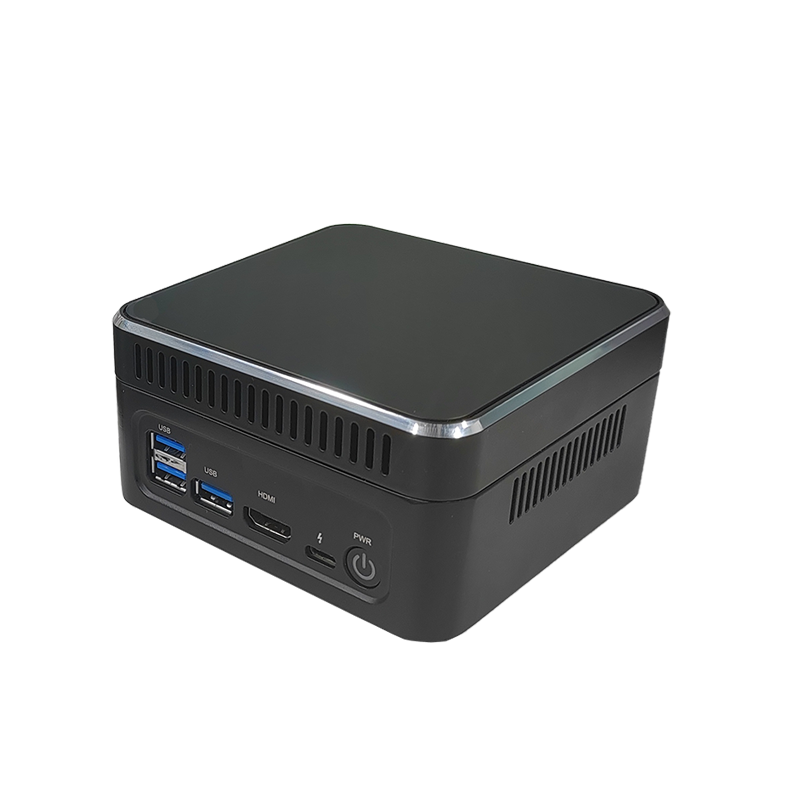
The setup can be a single LLM appliance on a desk, a GPU or NPU server in a rack, or a cluster in a company data centre. In each case the model weights are stored locally, inference happens locally and the surrounding tools, such as a private knowledge base or speech recognition, run alongside the model. The opposite is a cloud AI API, where the application sends each request over the internet to a provider’s model and receives the result.
Why are more companies moving language models in-house?
Three pressures push companies toward an on-premise LLM: data protection law, confidentiality of engineering and customer data, and predictable cost at steady usage. The weight of each depends heavily on the country and the industry.
In Germany, publications from IT security bodies and local consultancies frame local AI as a way to keep control of sensitive data under the GDPR rules on international transfers. Korean infrastructure suppliers point to Article 28-8 of the Personal Information Protection Act on cross-border transfer, and to the AI Basic Act that took effect in January 2026, as reasons why employees should not paste customer or HR data into overseas chatbots (example discussion, Korean). Brazilian integrators make a similar case around LGPD (Law 13.709/2018), and Russian companies around data-localisation rules in Federal Law 152-FZ. In manufacturing, the bigger concern is often not personal data at all, but drawings, process recipes, quality records and supplier prices.
How do data residency rules differ by region?
Most privacy laws do not ban cloud AI outright; they set conditions for sending personal data across borders, so the practical question is whether those conditions are easy to meet for your data. The table is a simplified orientation, not legal advice.
| Region | Main instrument | What it means for AI prompts |
|---|---|---|
| European Union | GDPR; EU AI Act (Regulation 2024/1689) | Transfers outside the EU need an adequacy decision or safeguards; the AI Act adds risk-based duties for certain AI uses |
| Brazil | LGPD, Law 13.709/2018 | International transfers allowed only on the legal bases listed in the law |
| India | Digital Personal Data Protection Act 2023 | Transfers generally allowed, but the government may restrict transfers to specified countries; sector rules may be stricter |
| Saudi Arabia | Personal Data Protection Law (PDPL), overseen by SDAIA | Transfers outside the Kingdom are permitted only under defined conditions |
| South Korea | Personal Information Protection Act, Art. 28-8 | Cross-border transfer needs consent or another recognised basis |
| Russia | Federal Law 152-FZ | Personal data of Russian citizens must be initially recorded and stored in databases located in Russia |
If prompts and retrieved documents contain no personal data and no confidential material, a cloud AI API may be entirely appropriate. If they do, an on-premise LLM removes the transfer question for that workload and gives you full data sovereignty over it, though the other obligations of each law, such as security, purpose limitation and records, still apply on your own servers.
On-premise LLM vs cloud AI API: how do they compare?
Cloud AI wins on model quality ceiling and elasticity; on-premise wins on data control, offline operation and cost predictability once usage is steady. The comparison below lists the factors buyers usually weigh.
| Factor | On-premise LLM | Cloud AI API |
|---|---|---|
| Data location and data sovereignty | Stays inside your network | Processed in the provider’s regions |
| Model choice | Open-weight models sized to your hardware | Largest frontier models available |
| Cost profile | Up-front hardware plus power and support | Pay per token; scales with use |
| Offline and latency | Works without internet; local network latency | Needs connectivity; latency varies |
| Operations | You patch, monitor and update models | Provider operates the service |
| Change control | Model version fixed until you change it | Provider may update or retire models |
A 2025 cost-benefit study of on-premise LLM deployment on arXiv found that the break-even point against commercial APIs depends strongly on request volume and on the model size chosen, which matches what most buyers find in pilots: low or irregular usage favours the cloud, steady high usage favours owned hardware.
Which workloads suit an on-premise LLM best?
The strongest candidates are workloads that combine sensitive data with repetitive questions over a fixed body of documents. These are exactly the cases where retrieval-augmented generation (RAG) on a private knowledge base works well with compact open models.
- Maintenance and service assistants that answer questions from manuals, wiring diagrams and fault histories.
- Quality and compliance search across procedures, audit records and customer specifications.
- Sales and engineering support over price lists, drawings and past quotations that must not leave the company.
- Meeting minutes, speech-to-text and translation for internal meetings.
- Front-desk and kiosk assistants that must keep working when the internet link is down.
Open-ended creative writing, complex multi-step reasoning across the open web, or very large context windows still tend to favour frontier cloud models. Many companies end up with a hybrid AI setup: confidential work stays local, while general tasks with non-sensitive data go to the cloud.
What hardware does an on-premise LLM need?
The hardware is sized by the model you choose, the number of simultaneous users and the response speed they accept, so start from the workload rather than from a server catalogue. Compact models with INT8 or lower-precision quantisation run on edge NPUs; larger models and fine-tuning need GPU servers.
Three practical tiers cover most industrial buyers. A low-power appliance serves a department or site with a private knowledge base and speech tools. A rack server serves many users or runs larger models and some training. Clusters are for central IT teams serving the whole company. Whatever the tier, run a pilot with your own documents and measure answer quality, speed and concurrency before buying in volume, because vendor figures are measured on vendor workloads.
How do you plan a private LLM deployment?
Treat it as a small IT project with a clear use case, a data owner and an exit plan, not as a hardware purchase. This checklist keeps pilots focused:
- Pick one or two use cases and the documents they need; name a data owner.
- Classify the data: personal, confidential, export-controlled or public.
- Check the relevant law (GDPR, LGPD, DPDP Act, PDPL, PIPA, 152-FZ) with your legal team.
- Shortlist open models and test them in your languages on your own questions.
- Define users, concurrency and acceptable response time; size hardware from that.
- Plan access control, logging and how documents are added or removed from the knowledge base.
- Budget total cost of ownership: hardware, power, support, model updates and staff time.
- Decide which tasks may still use a cloud AI API and how that boundary is enforced.
Which TouchVision appliances support on-premise AI?
TouchVision builds compact on-premise AI appliances aimed at departments and sites that want a private knowledge base and AI tools without a data-centre project. Hardware is configured per project and sized with you during a pilot.
The YZ-B033 on-premise LLM appliance is built on the Sophgo BM1684X processor, rated at 32 TOPS INT8 with FP32, FP16 and BF16 support. It runs DeepSeek and Qwen models, with others on request, and provides knowledge-base Q&A over PDF, TXT, DOCX, PPTX and image files, text-to-image, image and video search by text, speech recognition, text-to-speech and code generation, all processed on the device. It has two LAN ports, typical power of about 17 W and an operating range of −20 to +70 °C; memory and storage are configured on request. The palm-sized AI Super Agent adds digital-human avatars, meeting minutes, natural-language data Q&A and MCP/API integration. For heavier workloads, see the on-premise AI server range, and for video analytics at the edge, our guide to edge AI boxes.
About TouchVision. TouchVision has designed and manufactured industrial touch displays, embedded boards, panel PCs, IoT gateways and edge AI computers since 2012, from standard models to full OEM/ODM projects. Standard products carry a 3-year warranty from delivery. For bespoke builds, see our custom AI appliance options on the TouchVision OEM/ODM site, or read about us.
Frequently asked questions
Is an on-premise LLM more secure than a cloud AI API?
It removes the external provider from the data path, which reduces transfer and third-party risk. Security still depends on your own access control, patching, logging and network design.
Can a small appliance run a useful private LLM?
Yes, for compact open models with quantisation, especially for knowledge-base Q&A and speech tasks. Large frontier-class models need GPU servers. Test the model sizes you need in a pilot.
Does GDPR forbid using cloud LLMs?
No. GDPR allows transfers outside the EU with an adequacy decision or appropriate safeguards. Many companies still prefer local processing for personal or confidential data to avoid the analysis altogether. Ask your legal advisor.
What is RAG and why does it matter on-premise?
Retrieval-augmented generation looks up relevant passages from your own documents and gives them to the model with the question. It lets a compact local model answer accurately from company knowledge without retraining.
Which models run on the TouchVision YZ-B033?
The YZ-B033 supports DeepSeek and Qwen models, with other models on request. We confirm model size and performance against your use case before delivery.
Sources and standards referenced
- EUR-Lex: Regulation (EU) 2024/1689 (AI Act)
- GDPR Chapter 5: Transfers to third countries
- Brazil: Lei 13.709/2018 (LGPD), Portuguese
- MeitY India: Data protection framework
- Nodemall: why teams build in-house LLMs (Korean)
- arXiv 2509.18101: Cost-benefit analysis of on-premise LLM deployment
- Sophgo: BM1684X
Need a recommendation for your project?
Send your drawings, quantities and environment through our RFQ form and a TouchVision engineer will reply with a recommended configuration, quotation and sample plan. You can also call or WhatsApp +86 135 0532 6001.