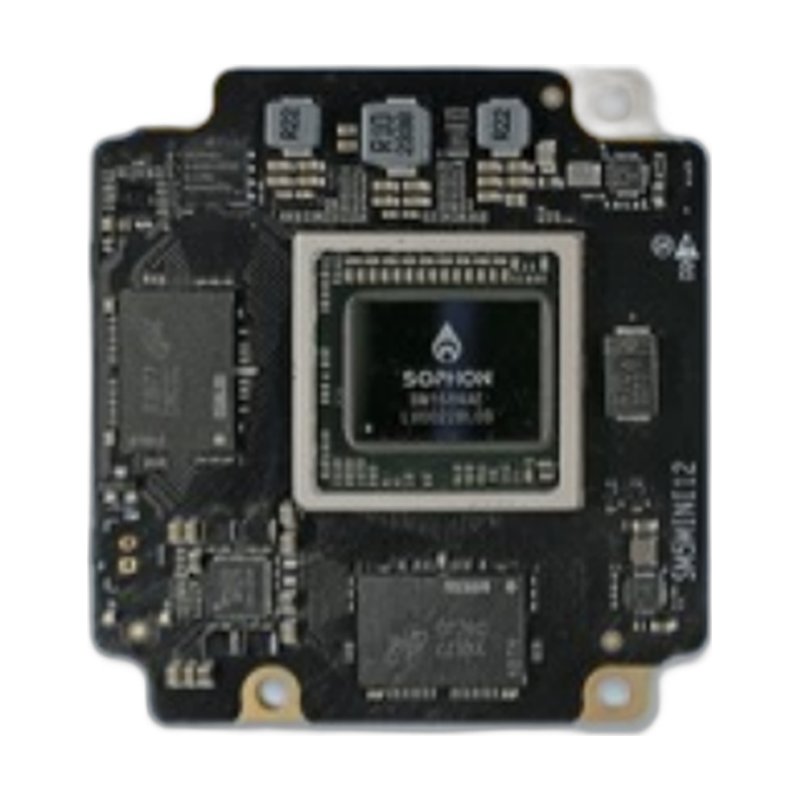
A compact AI core board, two-thirds the size of a credit card, built on SOPHGO BM1684 or BM1684X. It adds 17.6–32 TOPS INT8 of on-device inference and hardware H.264/H.265 video to your own NVR, robot, drone or edge-gateway design through a 144-pin board-to-board connector.
Overview
The TouchVision AI Edge Computing Module puts a complete SOPHGO AI computer on a 62 × 58 × 33 mm core board. An 8-core Arm Cortex-A53 at 2.3 GHz runs Linux and your application. The TPU delivers 17.6 TOPS INT8 (BM1684) or 32 TOPS INT8 (BM1684X) for deep-learning inference, and a hardware video engine encodes and decodes H.264/H.265 in real time.
The module connects to the carrier board through a single 144-pin board-to-board connector that exposes Gigabit Ethernet, PCIe 3.0, GPIO, SDIO, PWM and I²C. OEMs can design their own carrier for a smart NVR, robot controller, drone payload or edge gateway, or TouchVision can design and build the carrier as an ODM project. The same toolchain used on TouchVision’s YZ-series edge AI boxes applies: TensorFlow, Caffe, MXNet, PyTorch, ONNX and PaddlePaddle models, Docker containers, Python, OpenCV and FFmpeg acceleration, and open-source LLMs such as DeepSeek and Qwen.
Key features
- SOPHGO BM1684 or BM1684X AI computing platform
- 8-core Arm Cortex-A53 @ 2.3 GHz main processor
- 17.6 TOPS INT8 (BM1684) or 32 TOPS INT8 (BM1684X)
- Real-time H.264/H.265 HD hardware encoding and decoding
- 62 × 58 × 33 mm, about two-thirds the size of a credit card
- 144-pin board-to-board connector; Gigabit Ethernet, PCIe 3.0, GPIO, SDIO, PWM, I²C
- TensorFlow, Caffe, MXNet, PyTorch, ONNX and PaddlePaddle models; Docker, Python, OpenCV, FFmpeg
- Runs open-source LLMs such as DeepSeek and Qwen, and hosts private models
- Less than 1 W per TOPS (INT8); compatible with fanless passive cooling
Specifications
| Item | Specification |
|---|---|
| AI SoC | SOPHGO BM1684 / BM1684X |
| CPU | 8× Arm Cortex-A53 @ 2.3 GHz |
| AI Performance | 17.6 TOPS INT8 (BM1684); 32 TOPS INT8 (BM1684X) |
| Video | H.264/H.265 real-time HD encoding and decoding |
| Form Factor | Core board, 62 × 58 × 33 mm |
| Connector | 144-pin board-to-board |
| Expansion Interfaces | Gigabit Ethernet, PCIe 3.0, GPIO, SDIO, PWM, I²C |
| Frameworks | TensorFlow, Caffe, MXNet, PyTorch, ONNX, PaddlePaddle |
| Large Models | DeepSeek, Qwen; private model hosting |
| Software | Docker, Python, OpenCV and FFmpeg hardware acceleration |
| Power Efficiency | < 1 W per TOPS (INT8) |
| Cooling | Fanless passive cooling supported |
Specifications are based on manufacturer data and may change. Ask for the latest datasheet for your configuration.
Applications
- Edge computing gateways
- Smart NVRs and video analytics appliances
- Service and industrial robots
- Drones and mobile inspection payloads
- OEM AI vision devices with a custom carrier board
Related industry solutions: AI Video Analytics & Smart Safety · Industrial Automation & Machine Builders
Customization and ordering
The BM1684X AI module can be customized for OEM projects, and small-batch pilot orders are supported. Request a quote or sample, chat on WhatsApp (+86 135 0532 6001), or read about our OEM/ODM service.
More in this category: Embedded Industrial Motherboards & ARM Single Board Computers · Related: Edge AI Computers & Video Analytics Boxes
Frequently asked questions
What is the difference between the BM1684 and BM1684X modules?
Both use an 8-core Cortex-A53 at 2.3 GHz. The BM1684 version delivers 17.6 TOPS INT8, and the BM1684X version delivers 32 TOPS INT8, which leaves more headroom for large language models and heavier vision models.
Can I design my own carrier board?
Yes. The module connects through a 144-pin board-to-board connector that exposes Gigabit Ethernet, PCIe 3.0, GPIO, SDIO, PWM and I²C. TouchVision can also design and manufacture the carrier board as an OEM/ODM project.
Does the module run large language models?
Yes. It supports open-source models such as DeepSeek and Qwen as well as private models, with Docker and Python development.
Does it need a fan?
Power consumption is under 1 W per TOPS, and the module is compatible with fanless passive cooling designs.